Static Light Scattering (SLS)
Static Light Scattering (SLS) provides absolute molecular weight determination and second virial coefficient measurement, essential for characterizing protein interactions and stability.
Static Light Scattering (SLS)
Light scattering is a well established technique to investigate properties of particles in solutions. Information such as size, molecular weight, diffusion and interaction strength are obtained. The basic principle is that a laser beam impinges on a sample and the scattered intensity is probed at a certain angle θ by a detector.
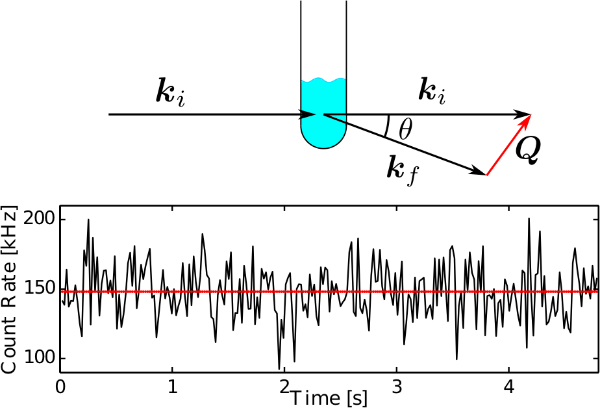
Figure 1: Scattering geometry (top) showing incoming wave vector ki, outgoing wave vector kf, scattering angle θ, and scattering vector Q. Intensity fluctuations over time (bottom) measured in a typical DLS/SLS experiment.
From the intensity fluctuations in time (see Figure 1), information on the dynamics within the solution are obtained. The evaluation of the fluctuations is commonly named as dynamic light scattering (DLS) while the analysis of the absolute mean intensity is known as static light scattering (SLS). The intensity is very sensitive to variations in size of the solutes, so that it is advantageous to investigate aggregation in solution.
The Scattering Vector Q
The scattering vector Q is defined as the difference between the outgoing and incoming wave vector, and its magnitude is:
Q = (4πn / λ) · sin(θ/2)
Scattering Vector Magnitude
Key Quantities in Static Light Scattering
The main quantities influencing the static light scattering intensity are the molecular weight M, concentration and size of the particles in solution. Due to the long wavelength, particles of size of nanometers (typical for proteins) can be interpreted as (independent) scattering centers whose intensity interferes constructively. If the particles are big enough (>λ/20), an angle dependent change in intensity can be observed.
The Rayleigh ratio R ∝ Is is introduced as a quantity independent of the experimental setup. To have a direct estimation of the results, the scattering intensity is normalized by the solute concentration c and reduces for small concentration to:

Zimm Equation (Debye Plot)

If the particles are big in size or interacting strongly, further angular and concentration dependent corrections have to be considered, arising from the form and structure factor (e.g. see SAXS).